Saturday, April 30, 2011

Zombie a.k.a Undead

View Image


        zombie is a creature that appears in books and popular culture typically as a reanimated dead or a mindless human being. They are among the lower forms of the undead, and often appear in large numbers. No one is certain about the origins of these pathetic and horrible things.

Stories of zombies originated in the Afro-Caribbean spiritual belief system of Vodoo, which told of the people being controlled as laborers by a powerful wizard.

Zombies became a popular device in modern horror fiction, largely because of the success of George A. Romero's 1968 film Night of the Living Dead.  Today, the modern zombie serves as a generic term that encompass a large variety of different undead-or-not creatures.

You want to know more about the origin of zombies, the possible causes and how to stay alive in case of a Zombie Apocalypse?

Definition of zombies

Zombies have been confused with many other monstrous creatures. Monstrous will try to make a clear distinction between the different entities that proceed from death.

To study the zombie as a creature, it is important to understand exactly what a zombie is. First, we need to differentiate between two common terms used for zombies, Undead and Zombie.

Undead is a collective name for fictional, mythological, or legendary beings that are deceased yet behave as if alive. Undead may be incorporeal, such as ghosts, or corporeal, such as vampires and zombies. Undead are featured in the legends of most cultures and in many works of fantasy and horror fiction. A zombie is a dead person that is brought back to life through a curse (voodoo, necromancy) or a mutation and has recovered some vital functions like movement.

They are speechless, near-mindless, possessing little reasoning power, though many can perform automatic movement and "remembered behaviors" from their mortal existence.

Zombies are omnipresent in the folklore of Haiti, where they are created by voodoo, an African type of black witchcraft. More recently, zombies films have exposed new theories according to which man-made virus or genetic experiments are held responsible for the creation of zombies. Such films put a strong emphasis on flesh and blood: rotting bodies and their attendant maggots, as well as the still-warm gore resulting from savage, often cannibalistic attacks upon the living.

Types of zombies

The first approach of a zombie taxonomy that aims to classify zombie types is by studying the possible origins of zombies.

Two kinds of zombies exists in modern popular culture: one created by voodoo resulting in a spell-bound near dead state, and cannibal creatures created by scientific experimentation of strange chemicals on living humans (as popularized by a series of films on the "living dead" theme).

Zombies can also be classified according to their physical and mental characteristics. There are the slow zombies and the new breed of fast zombies found in 28 days later or Zombieland. Purists will argue that the latter are not technically zombies but infected living humans.


View Image

Aikido & Hapkido

Aikido
       
    Aikido is considered to be a non-aggressive style, as the Aikido student does not instigate the attack. The basic principle of Aikido is “Do not fight force with force”. Aikido uses very few punches and kicks. Instead, the attackers force is redirected into throws, locks and restraining techniques. Size, weight, age and physical strength differences of the opponents play only a small role, as the skilled Aikido practitioner is able to redirect the attackers energy, keeping his attacker in a constant of unbalance.
AikidoTo be effective, Aikido takes longer to learn than most other martial arts. Aikido can be practiced to a late age because this martial art does not rely on flexibility, muscle speed, or strength. Thus it has become especially popular with women and senior citizens.

Aikido training teaches the use of several martial arts weapons such as Tento, Jo and Bokken. There is also a sport style of Aikido named Tomiki Aikdo.

Origin of Aikido: Japan
Founder of Aikido: Morihei Ueshiba 1883-1969
Popularised by: Movie star Steven Seagal, the first Western person to open an Aikido school in Japan.


Hapkido


Hapkido is a Korean martial art, and combines techniques from Karate, Aikido and Judo. It also draws influence from other native Korean martial arts. Characteristic for Hapkido are the wrist locks and throws that can look quite spectacular. Hapkido uniforms are available in white and black and have a characteristic diamond pattern.

Developed in the 1940s and 50s, its founder Grandmaster Choi had learned martial arts first in Japan, in a school of Daito-Ryu Aiki-Jujutsu, an ancient form of Jujutsu that was practiced mostly by Samurai.
On Choi’s return to Korea, he added many techniques to defend against particular types of attacks, and borrowed heavily from other styles. The name of what is known as Hapkido today changed several times, and famous students of Choi such as Ji Han Jae continued to develop the art and were instrumental in bringing Hapkido to the west, where it was taught to FBI and other US government agencies.
hapkido bruce leeDuring this time Ji Han Jae met Bruce Lee, who was very impressed with the techniques of Hapkido. Ji Han Jae coached Bruce Lee, who then went on and incorporated certain aspects of Hapkido into the development of his own emerging style, Jeet Kune Do.

Origin of Hapkido: Korea
Founder of Hapkido: Yong Shui Choi (also known as Choi Yong Sul)
Popularised by: Grandmaster Ji Han Jae (Founder of Sin Moo Hapkido) in the unfinished “Game of Death” movie by Bruce Lee

Martial Arts Ninjutsu

View Image


        Ninjutsu is the practised art of the Ninja. Ninjutsu is a Japanese martial art that emphasizes stealth in movement and camouflage. Ninjas were a group of mercenaries in feudal Japan who were trained in stealth and the martial arts and employed as spies, saboteurs, or assassins.

The two oldest styles of Ninjutsu that are still practiced today are Iga Ryu and Koga Ryu. Ninja are skilled in a variety of martial arts including Judo, Jujutsu and swordsmanship. Ninja use a shorter sword than the Samurai and prefer to carry it strapped to their back. As well as these martial arts they are skilled in a variety of Ninja weapons - such as the shuriken (throwing star), throwing knives, stick fighting, and chain arts.

The Ninja originally were also experts at disguise and concealment, which enabled them to gather information or act as assassins for Japanese warlords. This was work that others, such as the Samurai - who were bound by their strict code of Bushido - were reluctant to perform.

Ninjutsu went through an incredible boom period in the mid eighties due to the emergence of famous Ninjutsu instructors, such as Stephen Hayes. Ninjutsu still remains popular the world over.

Origin of Ninjutsu: Japan

Ninjutsu founded: Around 900 years ago

Popularised by: Dr Masaaki Hatsumi, 34th grandmaster of Togakure Ryu Ninjutsu and Stephen Hayes

Karate Martial Arts

View Image


         Karate translates, as is generally accepted, to Empty Hand in Japanese. Karate is a martial art that uses weaponless techniques such as punching and kicking to overcome the opponent. Typically, fighters wear a white Karate Uniform (Gi) and a belt that indicates their skill level and rank.

The development of Karate began in Okinawa, an island south of Japan. Okinawans travelled to China, where they learnt the Chinese martial arts. On their return to Okinawa they set about blending their own martial arts (initially simply called Te, “Hands”) with what they had learnt in China and called it To-De, Chinese Hands.

From this, 4 main styles of Karate developed - Goju Ryu, Shorin Ryu, Uechi Ryu and Shorei Ryu. Gichin Funakoshi, who trained under several Okinawan Karate masters, developed his own style of Karate that he named Shotokan.

Funakoshi introduced Shotokan to Japan in the early 20th century. Other Okinawan masters soon followed him - Chojun Miyagi with Goju Ryu and Kenwa Mabuni with Shito Ryu. From these masters many new styles were soon developed. For example Kyokushinkai by Mas Oyama, Goju Kai by Gogen Yamaguchi, Wado Ryu by Hinonori Ohtsuka.

There are now hundreds of different styles of karate across the world, but all
can be traced back to the original four from Okinawa.

Origin of Karate: Okinawa

Karate was founded in the 16th century and formalised into different styles in the early 20th century.

Karate is currently popularised by:

Wushu Martial Arts

Martial Arts are traditional Chinese sports which have developed over a long historical period. In order to survive the extremely hostile environment, our primitive Chinese ancestors learned some primary means of attack and defence such as leaping, tumbling and kicking. Moreover, they generally knew how to fight with weapons made from stones and wood or bare-hand fighting. This is considered to be the origin of martial arts.

The movements in martial art include kick, boxing, wresting and seizing, which are performed by rules. Sects of martial arts are various. Generally speaking, Shaolin Sect and Wudang Sect are the two most famous sects. As the old Chinese saying goes 'In the north, Shaolin Kungfu is primarily recommended. While in the south, Wudang Kungfu is especially valued.' Both of them lay emphasis on the external practice for Jing (genuine energy), Qi (vital energy) and Shen (spirit) and internal practice for muscle, bone and skin.

 Shaolin Martial Arts
Shaolin Martial Arts
Being an important part of Chinese traditional martial arts, Shaolin martial arts are considered to be the authentic Chinese kungfu. Originally, Shaolin Kungfu was developed from the Shaolin Temple, in the region of Song Mountain. While cultivating in the thick forest of the high mountains, monks created a set of body-building exercises by learning the postures of flying, jumping and running from birds, beasts and fish. Gradually, these body-building exercises developed into a sort of boxing through long practice and improvement, which is generally called 'Shaolin boxing'.
Shaolin martial arts include boxing, stick art, spear art, sword art and so on. Shaolin boxing is strong and powerful. It is a combination of attack and defence thus making it practical for real fights. Stick art played an important role in wars. It can not only defeat the enemy and achieve victory, but also improve health and promote longevity. Spear is regarded as the king of the ancient weapons. Spear arts are various, including Shaolin spear, Yezhan spear, Lanmen spear and so on. Sword arts have a far-reaching influence on the Shaolin martial arts. The vigorous sword dance brings people a wonderful aesthetic feeling.
 See Videos of Shaolin Kung Fu

 Wudang Martial Arts
Tai Chi Quan Performance
Wudang martial arts are greatly related to the Chinese native religion - Taoism. It is said that Zhang Sanfeng, a Taoist who lived in the Song Dynasty (960-1279) created Wudang martial arts. The Ming Dynasty (1368-1644) saw the formal popularity of Wudang Kungfu. In order to promote Wudang Taoism all over China, Emperor Yongle of the Ming Dynasty assembled 300,000 civilian workers to build 33 Taoist complexes in Mt. Wudang. It took them 13 years to finish the whole construction. Wudang Kungfu emphasizes the strengthening of bones and muscles and internal cultivation, and encourages the use of softness to conquer the unyielding. It doesn't advocate attack but at the same time it is hard to defeat.
Shadow boxing, Bare-hand fighting in six steps, Wuji boxing are all types of Wudang Kungfu. Wudang Sword is regarded as Wudang's priceless treasure. Taiji Sword, Liuhe Spear, Baihong Sword are also famous Wudang weapons.
The basic Wushu spirit is to value martial arts while at the same time upholding virtue;  this has been advocated by martial arts performers from generation to generation. Chinese martial arts are just like a knowledgeable teacher from whom people can learn a lot in order to survive in this complicated world.

Nuclear Weapon

      
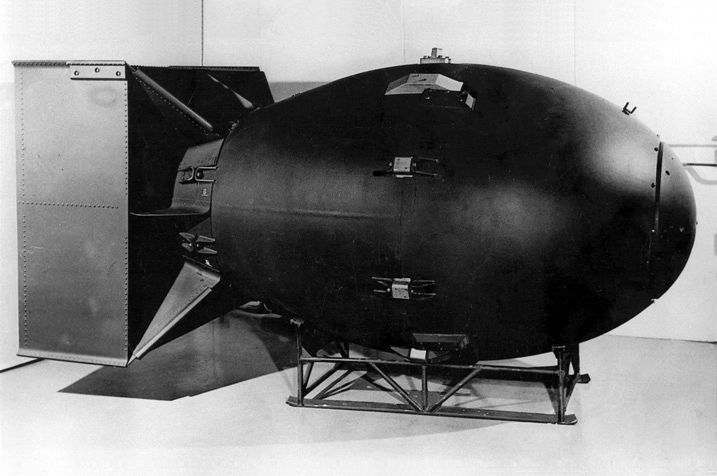
File:Fat man.jpg


      A nuclear weapon is an explosive device that derives its destructive force from nuclear reactions, either fission or a combination of fission and fusion. Both reactions release vast quantities of energy from relatively small amounts of matter. The first fission ("atomic") bomb test released the same amount of energy as approximately 20,000 tons of TNT. The first thermonuclear ("hydrogen") bomb test released the same amount of energy as approximately 10,000,000 tons of TNT.

A modern thermonuclear weapon weighing little more than 2,400 pounds (1,100 kg) can produce an explosive force comparable to the detonation of more than 1.2 million tons (1.1 million metric tons) of TNT. Thus, even a small nuclear device no larger than traditional bombs can devastate an entire city by blast, fire and radiation. Nuclear weapons are considered weapons of mass destruction, and their use and control has been a major focus of international relations policy since their debut.

Only two nuclear weapons have been used in the course of warfare, both by the United States near the end of World War II. On 6 August 1945, a uranium gun-type device code-named "Little Boy" was detonated over the Japanese city of Hiroshima. Three days later, on 9 August, a plutonium implosion-type device code-named "Fat Man" was exploded over Nagasaki, Japan. These two bombings resulted in the deaths of approximately 200,000 Japanese people—mostly civilians—from acute injuries sustained from the explosions. The role of the bombings in Japan's surrender, and their ethical status, remain the subject of scholarly and popular debate.

Since the bombings of Hiroshima and Nagasaki, nuclear weapons have been detonated on over two thousand occasions for testing purposes and demonstrations. Only a few nations possess such weapons or are suspected of seeking them. The only countries known to have detonated nuclear weapons—and that acknowledge possessing such weapons—are (chronologically by date of first test) the United States, the Soviet Union (succeeded as a nuclear power by Russia), the United Kingdom, France, the People's Republic of China, India, Pakistan, and North Korea. In addition, Israel is also widely believed to possess nuclear weapons, though it does not acknowledge having them. One state, South Africa, has admitted to having previous fabricated nuclear weapons in the past, but has since disassembled their arsenal and submitted to international safeguards.


Types of nuclear weapons
There are two basic types of nuclear weapon. The first type produces its explosive energy through nuclear fission reactions alone. Such fission weapons are commonly referred to as atomic bombs or atom bombs (abbreviated as A-bombs), though their energy comes specifically from the nucleus of the atom.
In fission weapons, a mass of fissile material (enriched uranium or plutonium) is assembled into a supercritical mass—the amount of material needed to start an exponentially growing nuclear chain reaction—either by shooting one piece of sub-critical material into another (the "gun" method) or by compressing a sub-critical sphere of material using chemical explosives to many times its original density (the "implosion" method). The latter approach is considered more sophisticated than the former and only the latter approach can be used if the fissile material is plutonium.

A major challenge in all nuclear weapon designs is to ensure that a significant fraction of the fuel is consumed before the weapon destroys itself. The amount of energy released by fission bombs can range from the equivalent of less than a ton of TNT upwards of 500,000 tons (500 kilotons) of TNT.

The second basic type of nuclear weapon produces a large amount of its energy through nuclear fusion reactions. Such fusion weapons are generally referred to as thermonuclear weapons or more colloquially as hydrogen bombs (abbreviated as H-bombs), as they rely on fusion reactions between isotopes of hydrogen (deuterium and tritium). However, all such weapons derive a significant portion, and sometimes a majority, of their energy from fission (including fission induced by neutrons from fusion reactions). Unlike fission weapons, there are no inherent limits on the energy released by thermonuclear weapons. Only six countries—United States, Russia, United Kingdom, People's Republic of China, France and India—have conducted thermonuclear weapon tests. (Whether India has detonated a "true", multi-staged thermonuclear weapon is controversial.)


The basics of the Teller–Ulam design for a hydrogen bomb: a fission bomb uses radiation to compress and heat a separate section of fusion fuel.


Thermonuclear bombs work by using the energy of a fission bomb to compress and heat fusion fuel. In the Teller-Ulam design, which accounts for all multi-megaton yield hydrogen bombs, this is accomplished by placing a fission bomb and fusion fuel (tritium, deuterium, or lithium deuteride) in proximity within a special, radiation-reflecting container. When the fission bomb is detonated, gamma and X-rays emitted first compress the fusion fuel, then heat it to thermonuclear temperatures. The ensuing fusion reaction creates enormous numbers of high-speed neutrons, which can then induce fission in materials not normally prone to it, such as depleted uranium. Each of these components is known as a "stage", with the fission bomb as the "primary" and the fusion capsule as the "secondary". In large hydrogen bombs, about half of the yield, and much of the resulting nuclear fallout, comes from the final fissioning of depleted uranium.

By chaining together numerous stages with increasing amounts of fusion fuel, thermonuclear weapons can be made to an almost arbitrary yield; the largest ever detonated (the Tsar Bomba of the USSR) released an energy equivalent of over 50 million tons (50 megatons) of TNT. Most thermonuclear weapons are considerably smaller than this, due to practical constraints arising from the space and weight requirements of missile warheads.

There are other types of nuclear weapons as well. For example, a boosted fission weapon is a fission bomb which increases its explosive yield through a small amount of fusion reactions, but it is not a fusion bomb. In the boosted bomb, the neutrons produced by the fusion reactions serve primarily to increase the efficiency of the fission bomb. Some weapons are designed for special purposes; a neutron bomb is a thermonuclear weapon that yields a relatively small explosion but a relatively large amount of neutron radiation; such a device could theoretically be used to cause massive casualties while leaving infrastructure mostly intact and creating a minimal amount of fallout.

The detonation of any nuclear weapon is accompanied by a blast of neutron radiation. Surrounding a nuclear weapon with suitable materials (such as cobalt or gold) creates a weapon known as a salted bomb. This device can produce exceptionally large quantities of radioactive contamination.

Most variation in nuclear weapon design is for the purpose of achieving different yields for different situations, and in manipulating design elements to attempt to minimize weapon size.

Pulau Sipadan

View Image

      
      Acknowledged as one of the best diving and unique spots in Southeast Asia, Pulau Sipadan is located off the small coastal town of Semporna on Sabah's eastern coast. Just 15 feet from the beach, the water turns indigo blue as the sea drops abruptly to 2,850ft deep! It is rather      awe-inspiring. Myriad of colorful tropical fish swim in the warm water near the surface whereas huge groupers nose about. Moreover, the water gets so dark that one would not really know what lurks below. This famous feature won Sipadan island a "Best Beach Dive in the World" award in 1993.
The sea is overflowing with marine life. The main attraction for divers is the rich and unique variety of corals both soft and hard. Reef fish of every shape and hue can be found in these waters. Colorful butterfly fishes, angel fishes, damsel fishes of electric blue and bright orange colors inhabit the coral reefs, thus adding to the splendor of the underwater havens.

Between April and September, the Green and Hawksbill turtles will come ashore in droves to nest in the soft golden sands of Sipadan. When you dive during this time, you are bound to encounter these harmless denizens of the deep.
A beautiful white-sand beach fringes Sipadan but the real beauty of this island is in its waters. The season for diving is from mid-February to mid-December. Visibility ranges from 60 feet to over 200 feet. Several dive spots have even been identified and given exotic names after the variety of corals and marine life that are unique to these spots. There is the "Hanging Gardens", the "Barracuda Point", and the exciting "Turtle Cavern".

Professional diving companies operate on the island, complete with water, electricity, food, drinks, and comfortable accommodation for an unforgettable experience. To get there, one can take the 45-minute boat ride from Semporna.